Kategorien
Neuer Blog
Wie können Sie einen Outdoor-Luftkühlventilator vor der Verschlechterung der IP68-Wasserdichtheitsversiegelung schützen?
September 07 , 2026Außenlüfter werden zunehmend in Geräten eingesetzt, die dauerhaft unter Regen, Feuchtigkeit, Staub, Temperaturschwankungen, Salznebel und anderen anspruchsvollen Umgebungsbedingungen arbeiten müssen. Telekommunikationsschränke, Außenstromversorgungen, Ladestationen für Elektrofahrzeuge, Solarwechselrichter, Industrieschaltschränke, Kühlsysteme, Landmaschinen, LED-Displays und viele andere Systeme sind auf einen Luftstrom zur Wärmeabfuhr angewiesen. Bei der Installation dieser Systeme im Freien ist die Kühlleistung jedoch nur ein Aspekt der Zuverlässigkeit. Ebenso wichtig ist die Fähigkeit des Lüfters, seinen Schutz vor Wasser und Staub über viele Jahre aufrechtzuerhalten.
EinLüfter mit Schutzart IP68Das Gerät bietet einen sehr hohen Schutz gegen Staub und Wasser. Die Schutzart IP68 ist jedoch keine Garantie dafür, dass die Dichtung dauerhaft intakt bleibt. Im Außenbereich ist das Gerät ständig mechanischen, thermischen, chemischen und Umwelteinflüssen ausgesetzt. Mit der Zeit können Dichtungen an Elastizität verlieren, Klebstoffe altern, Kabeleinführungen anfällig werden, Gehäuseverbindungen sich verformen und Kondenswasser Feuchtigkeit erzeugen, selbst wenn kein direkter Regen in das Gerät eindringt.
Dies bedeutet, dass der Schutz eines Außenlüfters vor einer Beeinträchtigung der IP68-Wasserdichtigkeit eine umfassende Zuverlässigkeitsstrategie erfordert und nicht einfach nur die Auswahl eines Lüfters mit IP68-Kennzeichnung.
Für Gerätehersteller und Ingenieure ist die wichtigste Frage daher nicht nur, ob ein Lüfter im Neuzustand einen IP68-Test besteht, sondern ob die Dichtungsstruktur, die Materialien, die elektrischen Komponenten, die Lager, die Kabelanschlüsse und die Installationsumgebung des Lüfters während der gesamten erwarteten Lebensdauer zuverlässig funktionieren können.
Was bedeutet IP68 genau für einen Außenlüfter?
Der IP-Code beschreibt den Schutzgrad eines Gehäuses gegen feste Fremdkörper und Wasser. Die erste Ziffer gibt den Schutz gegen feste Partikel an, die zweite den Schutz gegen Wasser. IP68 steht für einen hohen Staubschutz sowie Schutz gegen kurzzeitiges Untertauchen unter festgelegten Prüfbedingungen. Die genauen Bedingungen für das Untertauchen gemäß IP68 können von den vom Hersteller angegebenen Prüfbedingungen und den geltenden Anforderungen abhängen.
Diese Unterscheidung ist wichtig für die Auswahl von Außenventilatoren.
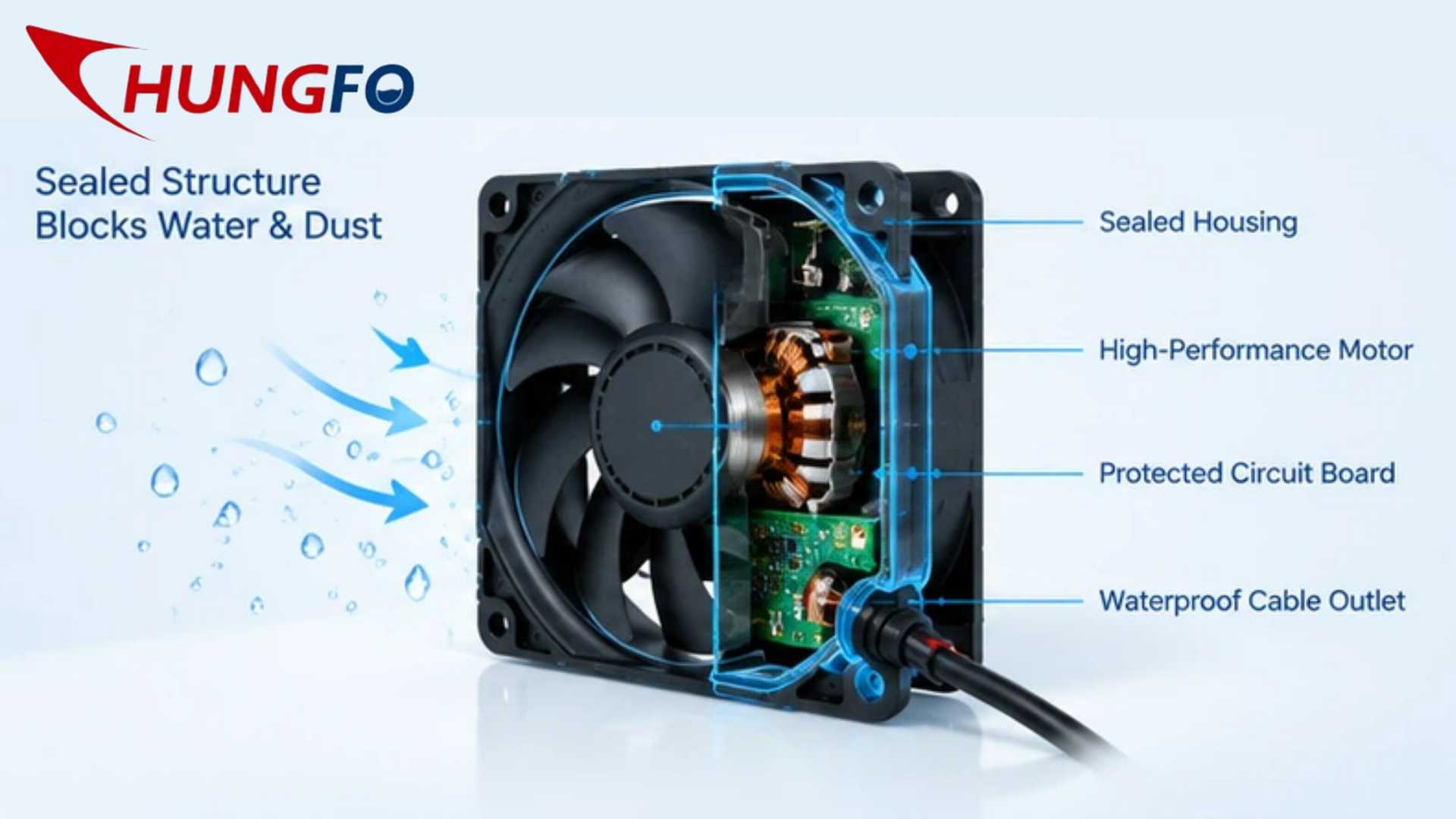
Ein IP68-Lüfter ist nicht einfach ein herkömmlicher Lüfter mit einer Gummikappe. Um zuverlässigen Schutz zu gewährleisten, müssen Hersteller üblicherweise mehrere potenzielle Eintrittspunkte für Wasser kontrollieren. Dazu gehören Gehäusefugen, Kabelausgänge, Steckverbinder, Motorgehäuse, Leiterplatten, Lagerbereiche und andere Schnittstellen.
Ein gut konstruierter, wasserdichter Lüfter kann durch die Kombination verschiedener Merkmale wie abgedichtete Gehäuse, Harzversiegelung, Schutzlackierung, wasserdichte Kabeldurchführungen, Speziallager, korrosionsbeständige Materialien und sorgfältig kontrollierte Fertigungsprozesse realisiert werden. Beispiele aus der Industrie zeigen, dass Verguss oder Kapselung zur Isolierung von Wicklungen und Leiterplatten gegenüber der äußeren Umgebung eingesetzt werden kann.
Der im Rahmen von Produktionstests gemessene Schutzgrad stellt jedoch nur einen bestimmten Zustand zu einem bestimmten Zeitpunkt dar. Außengeräte sind wiederholten Temperaturzyklen, Vibrationen, UV-Strahlung, chemischen Verunreinigungen und mechanischer Belastung ausgesetzt. Diese Faktoren können die Eigenschaften von Dichtungsmaterialien allmählich verändern.
Deshalb sollte der Langzeitschutz als ein ingenieurtechnisches Problem auf Systemebene betrachtet werden.
Warum können IP68-Wasserdichtungen mit der Zeit an Qualität verlieren?
Der häufigste Fehler bei der Planung von Außenkühlungssystemen ist die Annahme, dass Wasserdichtigkeit eine dauerhafte Eigenschaft des Produkts sei. Tatsächlich wird jedes Dichtungssystem von seiner Umgebung beeinflusst.
Temperaturschwankungen gehören zu den wichtigsten Faktoren.
Ein Außenventilator kann kalten Nächten, direkter Sonneneinstrahlung tagsüber, heißen Geräteoberflächen, plötzlichem Regen und saisonalen Temperaturschwankungen ausgesetzt sein. Kunststoffgehäuse, Gummidichtungen, Klebstoffe, Metallkomponenten und Harzmaterialien dehnen sich nicht unbedingt im gleichen Maße aus und ziehen sich im gleichen Maße zusammen.
Wiederholte Ausdehnung und Zusammenziehung können zu Spannungen an den Grenzflächen führen.
Wenn eine Dichtung härter, weicher, zusammengedrückt, aufgequollen oder dauerhaft verformt wird, kann ihr Anpressdruck allmählich abnehmen. Eine geringfügige Veränderung führt möglicherweise nicht sofort zu sichtbaren Leckagen, kann aber bei wiederholter Umwelteinwirkung einen Weg für Feuchtigkeit schaffen.
Thermische Zyklen sind auch deshalb wichtig, weil in elektronischen Gehäusen im Außenbereich Druckschwankungen auftreten können. Wenn sich die Luft im Inneren erwärmt und ausdehnt und anschließend abkühlt und zusammenzieht, kann es zu Druckschwankungen im Gehäuse kommen. Über längere Zeiträume können diese Zyklen schwache Dichtungen belasten. Untersuchungen an abgedichteten Gehäusen für den Außenbereich haben die thermische Ausdehnung und Kontraktion als mögliche Ursachen für Dichtungsausfälle und Kondensationsprobleme identifiziert.
Auch die UV-Strahlung ist ein Problem.
Im Außenbereich installierte Ventilatoren können tausende Stunden lang der Sonneneinstrahlung ausgesetzt sein. Je nach Material kann ultraviolette Strahlung zu Verfärbungen, Versprödung, Oberflächenrissen oder einem Verlust der mechanischen Eigenschaften führen. Daher ist die Auswahl geeigneter Materialien für den Außenbereich wichtig, wenn das Ventilatorgehäuse oder die Dichtungsstruktur direkter Sonneneinstrahlung ausgesetzt ist.
Die Luftfeuchtigkeit stellt eine weitere langfristige Herausforderung dar.
Eine feuchte Umgebung erfordert nicht zwangsläufig direkten Wasserkontakt, um Zuverlässigkeitsprobleme zu verursachen. Feuchtigkeit kann durch empfindliche Schnittstellen, Steckverbinder, Kabelstrukturen oder mikroskopische Defekte eindringen. Hohe Luftfeuchtigkeit kann zudem die Korrosion von Metallbauteilen und elektronischen Kontakten beschleunigen.
Salznebel kann besonders aggressiv sein.
Außengeräte in Küstennähe können salzhaltigen Luftpartikeln und Feuchtigkeit ausgesetzt sein. Salzverunreinigungen können die Korrosion von Metallteilen, Steckverbindern, Befestigungselementen und elektrischen Schnittstellen beschleunigen. Hersteller von Umweltventilatoren bieten daher häufig spezielle, korrosionsbeständige Ausführungen für Anwendungen mit Salznebel und Feuchtigkeit an.
Staub kann das Problem verschlimmern.
Staubpartikel können sich an Dichtungen und mechanischen Verbindungen ablagern. Enthält der Staub abrasive oder chemisch aktive Partikel, können wiederholte Bewegungen oder Vibrationen die Dichtfläche allmählich angreifen. Verbindet sich Staub mit Feuchtigkeit, bilden sich Ablagerungen, die sich schwerer entfernen lassen.
Wie kann das Lüftergehäuse die wasserdichte Dichtung schützen?
Das Lüftergehäuse ist die erste wichtige Verteidigungslinie gegen Umweltverschmutzung.
Ein robuster Außenventilator sollte über ein Gehäuse verfügen, das unnötige Öffnungen minimiert und kontrollierte Dichtungsflächen schafft. Je weniger unkontrollierte Öffnungen vorhanden sind, desto einfacher lässt sich ein zuverlässiger Umweltschutz gewährleisten.
Die Gehäuseverbindungen sollten sorgfältig konstruiert werden.
Eine einfache mechanische Verbindung bietet möglicherweise keinen ausreichenden Langzeitschutz, wenn die Kontaktflächen, die Dichtungskompression, die Toleranzen und die Befestigungsmethode nicht präzise kontrolliert werden. Je nach Konstruktion können Hersteller Dichtungen, Dichtmassen, Harzfüllungen, Vergussmassen, Umspritzung oder andere Technologien einsetzen.
Ziel ist es nicht einfach nur, das Gehäuse schwer zu öffnen. Ziel ist es, eine stabile Barriere gegen Wasser zu schaffen und gleichzeitig die mechanische Integrität bei Vibrationen und Temperaturwechseln zu gewährleisten.
Für Anwendungen mit besonders hohen Anforderungen an den Umweltschutz können interne elektronische Bauteile zusätzlich durch Beschichtung oder Verkapselung geschützt werden. Einige Lüfterkonstruktionen mit Schutzart IP68 nutzen Harztechnologien, um empfindliche Wicklungen und Leiterplatten vor Wasser und Feuchtigkeit zu isolieren.
Dieser Ansatz bietet eine zusätzliche Schutzebene.
Wenn das äußere Gehäuse einen kleinen Defekt aufweist, kann die innere Verkapselung die Wahrscheinlichkeit verringern, dass Feuchtigkeit an empfindliche elektrische Bauteile gelangt.
Warum ist die Kabeldurchführung ein kritischer Punkt für die Wasserdichtigkeit?
Viele Ingenieure achten sehr auf das Lüftergehäuse, unterschätzen aber den Kabelausgang.
Das Kabel muss vom geschützten Innenbereich in die Außenumgebung geführt werden. Dieser Übergang stellt eine unvermeidbare Schnittstelle dar.
Bei mangelhafter Konstruktion der Kabeldurchführung kann Wasser möglicherweise entlang des Kabels oder durch Spalten um die Kabeleintrittsstelle herum eindringen.
Aus diesem Grund werden bei wasserdichten Lüfterkonstruktionen häufig vorgeformte Kabelausgänge, Dichtungsmassen, Kabelverschraubungen, wasserdichte Steckverbinder oder andere kontrollierte Abdichtungsmethoden verwendet.
Auch das Kabelmaterial selbst spielt eine Rolle.
Außenkabel müssen Temperaturschwankungen, UV-Strahlung, Feuchtigkeit, Biegung, Vibrationen und mitunter auch Chemikalien standhalten. Ein Kabel, das im Innenbereich gut funktioniert, bietet im Außenbereich möglicherweise nicht die gleiche langfristige Zuverlässigkeit.
Die Verbindung zwischen Kabel und Lüfter sollte daher als Teil des gesamten wasserdichten Systems bewertet werden.
Die Verwendung eines hochwertigen IP68-Lüfters mit einem ungeschützten externen Anschluss kann eine Schwachstelle im Gesamtsystem darstellen. Der Lüfter selbst mag zwar einen hervorragenden Umweltschutz bieten, die fertige Gerätebaugruppe jedoch möglicherweise nicht.
Wie wirkt sich Kondensation auf die Zuverlässigkeit von IP68-Lüftern aus?
Wasserdichtigkeit und Kondensation sind zwei unterschiedliche Probleme.
Direkter Wassereintritt erfolgt, wenn flüssiges Wasser durch eine Öffnung oder eine beschädigte Dichtung eindringt. Kondensation tritt auf, wenn bereits in der Luft vorhandene Feuchtigkeit aufgrund von Temperaturänderungen zu flüssigem Wasser wird.
Diese Unterscheidung ist insbesondere bei elektronischen Außengeräten von Bedeutung.
In einem geschlossenen Gehäuse kann sich feuchte Luft befinden. Tagsüber erwärmen interne Komponenten die Luft. Nachts kühlt das Gerät ab. Erreicht die Innentemperatur den Taupunkt, kann Wasser an den kühleren Oberflächen kondensieren.
Daher kann es selbst in einem gut abgedichteten Gehäuse zu innerer Feuchtigkeit kommen, wenn die Wärmedämmung nicht ordnungsgemäß geregelt ist.
Bei Außenventilatorsystemen sollten daher sowohl der Schutz vor Wassereintritt als auch das Feuchtigkeitsmanagement berücksichtigt werden.
Bei manchen Gehäusekonstruktionen können atmungsaktive Membranen zum Druckausgleich und zur Begrenzung des Eindringens von Flüssigkeiten eingesetzt werden. Solche Lösungen müssen sorgfältig ausgewählt werden, da jede zusätzliche Belüftungskomponente den Gesamtschutz des Gehäuses beeinträchtigen kann. Die technischen Richtlinien für IP67- und IP68-Gehäuse betonen üblicherweise den Druckausgleich und das Kondensationsmanagement als wichtige Faktoren für die langfristige Zuverlässigkeit.
Wie wirken sich Temperaturänderungen auf Lüfterdichtungen aus?
Temperaturschwankungen sind im Laufe der Zeit oft schädlicher als ein einzelnes Hochtemperaturereignis.
Stellen Sie sich einen Außenlüfter vor, der in einem Schaltschrank betrieben wird. Tagsüber erwärmt die Sonneneinstrahlung den Schrank. Der Lüfter läuft mit hoher Drehzahl, da die internen elektronischen Bauteile Wärme erzeugen. Nachts kühlt das System schnell ab.
Dieser Zyklus kann sich täglich wiederholen.
Das Gehäuse dehnt sich aus und zieht sich zusammen. Dichtungsmaterialien reagieren unterschiedlich. Klebstoffe werden beansprucht. Kabelmäntel verändern ihre Abmessungen geringfügig. Schmierstoffe in Lagern reagieren auf Temperaturänderungen. Elektronische Bauteile sind zudem wiederholter thermischer Belastung ausgesetzt.
Over thousands of cycles, small changes can accumulate.
This is why outdoor fan qualification should consider the actual operating temperature range rather than only the nominal room-temperature condition.
Selecting a fan designed for the expected temperature range can significantly improve reliability.
The thermal design should also consider the difference between ambient temperature and the temperature inside the equipment. A fan operating in a 40°C outdoor environment may be exposed to a considerably higher internal temperature if the enclosure receives solar radiation or contains high-power electronics.
A suitable outdoor fan therefore needs both environmental protection and thermal capability.
How Can Material Selection Reduce Seal Degradation?
Material selection is one of the most effective ways to improve long-term environmental reliability.
Different rubber, plastic, resin, adhesive, and cable materials behave differently under ultraviolet radiation, heat, humidity, chemicals, and salt exposure.
For sealing applications, engineers should consider compression set, temperature resistance, chemical compatibility, water resistance, and aging characteristics.
For fan housings, material selection should consider mechanical strength, dimensional stability, flame resistance, corrosion resistance, ultraviolet exposure, and operating temperature.
For bearings, moisture resistance and lubricant stability are important.
For cables, flexibility, insulation performance, temperature resistance, and environmental durability should be evaluated.
A waterproof fan should therefore be selected as a complete engineered system rather than simply according to its external appearance.
How Important Are Bearings In An Outdoor Cooling Fan?
The waterproof seal protects electrical components, but the bearing system determines how reliably the impeller can rotate.
Outdoor environments can accelerate lubricant degradation and corrosion if the bearing structure is not suitable for the application.
Water exposure can be particularly damaging to conventional bearing systems.
A bearing that performs well in a clean indoor cabinet may experience different conditions in an outdoor agricultural machine, coastal power system, or industrial enclosure.
For long-life outdoor operation, engineers should consider bearing construction, lubricant characteristics, operating temperature, expected rotational speed, vibration, and environmental exposure.
Some manufacturers offer IP68 fans with specially protected ball bearings or other bearing solutions designed for demanding conditions.
The correct bearing selection also helps prevent secondary failures. If a bearing begins to develop excessive friction, the motor may consume more power, the fan may produce more heat, airflow can decline, and vibration can increase.
Therefore, bearing reliability is closely connected with the entire cooling system.
How Can You Protect An Outdoor Fan From Salt Spray?
Coastal installations require special attention.
Salt mist can reach outdoor equipment even when the fan is not directly exposed to seawater. Tiny salt particles can settle on surfaces and remain there when humidity is high.
Over time, salt contamination can accelerate corrosion.
The best strategy is to combine corrosion-resistant materials with appropriate sealing and, where necessary, additional surface protection.
Metal components should be selected according to the expected environmental conditions. Electrical connectors should have suitable environmental protection. The fan housing should prevent unnecessary exposure of sensitive components.
In particularly demanding applications, salt spray testing can provide useful information about material and surface durability.
A fan that is technically waterproof but uses materials that corrode rapidly may still have poor long-term reliability.
Therefore, IP68 should not be treated as a substitute for corrosion resistance.
How Can Installation Prevent IP68 Seal Damage?
Even the best waterproof fan can fail prematurely if it is installed incorrectly.
Mechanical stress is one of the most common installation-related problems.
If the fan frame is mounted against an uneven surface, excessive force can deform the housing. If screws are tightened unevenly, the sealing interface may experience uneven compression.
Cable routing is another important factor.
A cable should not be bent sharply near the sealed outlet unless the design specifically allows it. Excessive bending can place continuous mechanical stress on the cable entry.
The fan should also be positioned so that water does not remain unnecessarily around vulnerable interfaces.
If the application involves pressure washing, the direction and pressure of the water should be evaluated rather than assuming that an IP68 rating means unlimited resistance to every cleaning condition.
Installation instructions should therefore be treated as part of the waterproofing design.
Why Should You Avoid Relying Only On The IP68 Label?
The IP68 rating is valuable, but it is only one part of the product specification.
Two fans can both carry an IP68 designation while having different designs, materials, operating temperature ranges, expected lifetimes, corrosion resistance, bearing systems, and testing conditions.
For an outdoor application, engineers should ask additional questions.
What temperature range can the fan operate in?
What materials are used for the housing and sealing components?
How is the circuit board protected?
How is the cable outlet sealed?
What bearing technology is used?
Has the fan been tested under temperature cycling?
Has it been evaluated for salt spray?
What is the expected service life?
What are the airflow and static pressure characteristics?
Can the manufacturer provide reliability data?
These questions help transform IP68 from a marketing specification into a meaningful engineering parameter.
How Should You Test An Outdoor IP68 Fan?
Testing should simulate the actual environment as closely as possible.
A basic water ingress test is useful, but long-term reliability requires more than one test.
Temperature cycling can evaluate the effect of repeated expansion and contraction.
Humidity testing can help evaluate moisture resistance.
Salt spray testing can provide information about corrosion resistance.
Vibration testing can evaluate mechanical integrity.
High-temperature operation can reveal problems associated with seals, bearings, electronics, and lubricants.
Low-temperature testing can reveal changes in material flexibility and starting behavior.
Combined environmental testing can be even more valuable because real outdoor conditions rarely occur independently.
A fan may experience high temperature, humidity, vibration, and electrical load at the same time.
Manufacturers with appropriate testing capabilities can use environmental chambers, wind tunnel systems, pressure testing equipment, noise testing facilities, and other equipment to evaluate fan performance.
The purpose of testing should not be simply to obtain an IP rating. The objective should be to understand how the product behaves throughout its expected service life.
How Does Airflow Design Influence Waterproof Fan Reliability?
Waterproofing and airflow performance must be balanced.
Adding sealing structures, protective layers, or encapsulation can increase resistance to heat transfer or affect the internal thermal path.
At the same time, excessive restriction of the airflow path can reduce cooling performance.
An outdoor fan should therefore be selected according to the actual airflow and static pressure requirements of the equipment.
For example, asmall 12 volt dc mini fanmay be appropriate for a compact outdoor electronic module, but it may not provide sufficient airflow for a large industrial cabinet with high heat generation.
The key is not simply choosing the fan with the highest RPM.
A fan operating against high system resistance needs sufficient static pressure.
A fan operating in a relatively open airflow path may benefit more from high free-air volume.
This is why the fan performance curve should be considered during product selection.
The fan should be matched to the system operating point rather than selected based only on dimensions.
What Role Does Speed Control Play In Outdoor Fan Life?
Speed control can also contribute to long-term reliability.
If the fan operates at maximum speed continuously, it may generate more noise, vibration, power consumption, and mechanical stress than necessary.
If the equipment temperature varies significantly, variable-speed control can allow the fan to operate according to the actual cooling requirement.
PWM control is one possible method for controlling compatible DC fans.
By reducing unnecessary high-speed operation, the system may reduce mechanical stress and energy consumption.
However, speed control must be properly designed because operating a fan outside its recommended control range can affect starting reliability, acoustic performance, and motor temperature.
The appropriate control strategy depends on the fan design and the equipment requirements.
Choosing The Right Outdoor Fan For Different Applications
Outdoor telecom cabinets often operate continuously and can experience rain, dust, temperature fluctuations, and solar heating. A sealed DC cooling fan can help remove heat while limiting the risk of water and dust entering sensitive areas.
EV charging equipment presents another demanding application. Power electronics can generate substantial heat while the charger is installed outdoors. Waterproof cooling fans can help maintain thermal performance while improving environmental protection.
Solar inverter cabinets can also benefit from environmental fan solutions. Inverter electronics operate under varying outdoor temperatures, and reliable thermal management is essential for stable operation. Water ingress and condensation can create significant risks for electronic components, making environmental protection especially important.
Industrial automation equipment may be exposed to dust, humidity, oil mist, and vibration. The fan must therefore be selected according to the complete industrial environment rather than simply the expected temperature.
Agricultural equipment can face mud, moisture, dust, chemicals, and outdoor temperature fluctuations. In such conditions, corrosion resistance and mechanical durability become particularly important.
Marine and coastal equipment has an even stronger requirement for salt resistance.
Compact electronics may require a small waterproof fan. A Rocket RC Fan concept, for example, may be useful when discussing compact airflow requirements in remote-controlled equipment, hobby electronics, or small mechanical systems, but the exact environmental rating must always be confirmed from the actual product specification.
Why Should Manufacturers Consider Different Fan Structures?
Not every outdoor cooling requirement needs the same fan architecture.
Axial fans are widely used when a relatively large volume of air needs to move through a system with moderate resistance.
Centrifugal fans can be advantageous when the system requires stronger pressure against resistance.
Compact blowers may be useful when airflow needs to be redirected through a narrow duct or confined space.
An ac dc small fan can be useful when equipment requirements involve different power supply architectures or when the application needs a compact fan platform with flexible electrical configurations.
However, the electrical input should always be matched to the actual fan design.
A12V DC fan, a 24 V DC fan, and an AC fan should not be treated as interchangeable simply because their dimensions are similar.
How Can China Chungfo Fan Help With Outdoor Cooling Fan Selection?
For manufacturers developing outdoor electronic equipment, the fan is not an isolated component. It is part of the thermal and environmental protection system.
China Chungfo Fan focuses on cooling fan solutions for different equipment applications and can support requirements involving DC fans, AC fans, axial fans, centrifugal fans, blowers, and customized fan configurations.
The selection process should begin with the actual operating conditions.
The required voltage, airflow, static pressure, installation space, operating temperature, expected lifetime, noise requirement, environmental exposure, and protection level should all be considered together.
For an outdoor project, the application environment should be clearly described.
For example, a fan installed inside a sheltered outdoor cabinet has different requirements from a fan directly exposed to rain. A coastal application has different requirements from an inland factory. A solar inverter exposed to direct sunlight has different thermal conditions from an indoor control cabinet.
The more accurately the environment is defined, the more accurately the fan can be selected.
How Can You Build A Long-Term IP68 Protection Strategy?
The most effective strategy is to treat waterproofing as a lifecycle issue.
Start with the environment.
Identify rain, humidity, dust, salt, ultraviolet radiation, chemicals, vibration, temperature range, and cleaning requirements.
Then identify the thermal requirement.
Determine how much heat the equipment generates and where that heat needs to move.
After that, select the fan structure.
Choose axial, centrifugal, blower, or another design according to airflow resistance and available installation space.
Then evaluate the protection structure.
Look at housing sealing, cable exits, connectors, internal electronics protection, bearings, materials, and corrosion resistance.
Next, consider installation.
Make sure the mounting surface, screws, cable routing, drainage, and airflow direction do not compromise the sealing system.
Finally, test the complete system.
Do not test only the fan in isolation when the real application depends on the interaction between the fan and the equipment enclosure.
This system-level approach can greatly reduce the risk of premature waterproofing failure.
Maintenance Recommendations For Outdoor IP68 Fans
Even a highly protected fan should be included in the equipment maintenance plan.
The fan should be inspected periodically for visible damage, abnormal noise, vibration, corrosion, cable damage, and contamination.
The airflow path should remain clear.
Dust and debris can reduce airflow and increase motor load. If the fan is installed behind a protective grille or filter, that component should also be inspected.
In coastal environments, corrosion should be monitored more frequently.
If unusual vibration or noise appears, the fan should be evaluated before the problem becomes a complete failure.
Maintenance intervals should be based on the application environment rather than a universal schedule.
A clean indoor installation may require minimal inspection, while a coastal industrial installation may require much more frequent checks.
Common Mistakes When Using IP68 Outdoor Fans
One common mistake is assuming that IP68 means the fan can be exposed to any water condition indefinitely.
Another mistake is ignoring condensation.
A third mistake is installing an IP68 fan with a non-waterproof connector.
Another problem is selecting the fan based only on size.
Some engineers also focus on free-air airflow without considering system resistance.
Ignoring temperature is another common error. A fan may survive a short high-temperature event but have a much shorter service life if operated continuously at elevated temperatures.
Finally, some projects evaluate the fan but do not evaluate the complete enclosure.
The final equipment protection level depends on the complete system.
Conclusion
Protecting an outdoor air cooling fan from IP68 waterproof seal degradation requires much more than choosing a fan with a high IP rating.
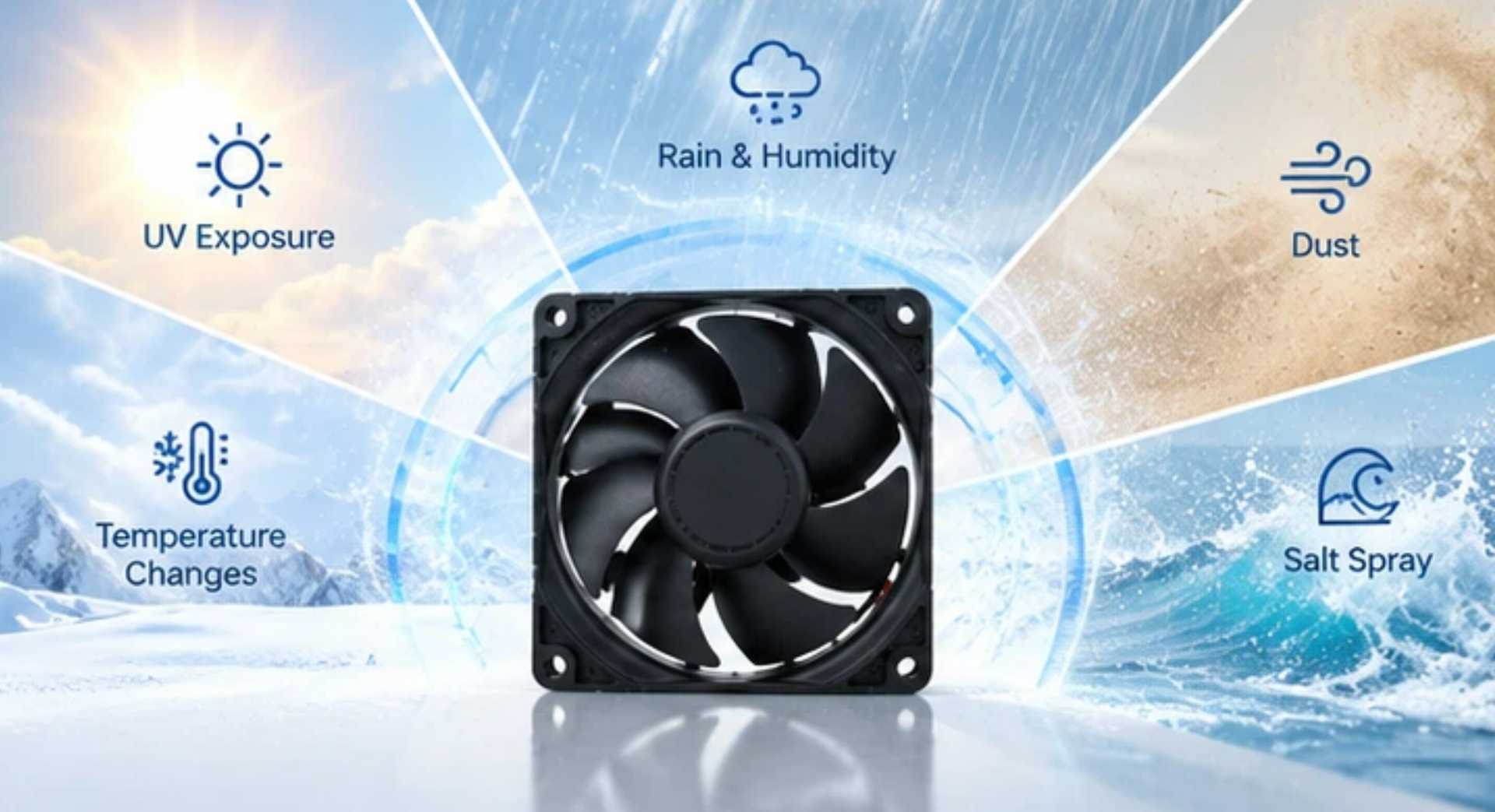
The long-term reliability of an outdoor fan depends on sealing design, material selection, housing construction, cable protection, bearing technology, corrosion resistance, temperature management, condensation control, installation quality, and environmental testing.
IP68 provides an important level of environmental protection, but it should be viewed as one part of a complete engineering strategy. Real outdoor applications expose cooling fans to thousands of hours of thermal cycling, humidity, rain, dust, vibration, sunlight, and sometimes salt mist. These conditions can gradually influence sealing materials and mechanical components.
The best approach is to select a fan according to the actual operating environment, not simply according to a product label.
For compact electronics, a small waterproof fan may provide an effective balance between airflow and protection. For larger cabinets, engineers may need higher airflow and static pressure. For high-humidity or coastal environments, corrosion resistance and internal electrical protection become increasingly important.
China Chungfo Fan can provide different cooling fan solutions according to application requirements. By combining suitable airflow performance with appropriate environmental protection, equipment manufacturers can create cooling systems that are more reliable, durable, and suitable for long-term outdoor operation.
The key principle is simple: IP68 protection should not be treated as a single specification. It should be treated as a long-term reliability system.
FAQ
What does IP68 mean for an outdoor cooling fan?
IP68 indicates a high level of protection against dust and water ingress under specified testing conditions. The exact immersion requirements should be confirmed from the manufacturer's test specification.
Does IP68 mean a fan will never leak?
No. IP68 describes performance under defined test conditions. Long-term outdoor exposure can affect seals, cables, materials, connectors, and other components.
Why do outdoor fan seals degrade?
Temperature cycling, ultraviolet exposure, humidity, chemicals, salt mist, vibration, mechanical stress, and material aging can gradually affect sealing performance.
Can condensation occur inside an IP68 enclosure?
Yes. Condensation can occur when humid air inside an enclosure cools below its dew point. Waterproofing and condensation management should therefore be considered separately.
Is IP68 enough for coastal applications?
Not necessarily. Coastal environments can involve salt mist and corrosion. Material selection, connector protection, corrosion resistance, and appropriate environmental testing should also be considered.
Why is the cable outlet important?
The cable outlet creates a transition between the internal protected area and the outside environment. Poorly protected cable entries can become a potential water ingress path.
Should an IP68 fan be tested for salt spray?
For coastal or salt-exposed applications, salt spray or other corrosion testing can be useful for evaluating long-term environmental durability.
Wie wähle ich den richtigen Außenventilator aus?
Beginnen Sie mit der Berücksichtigung von Spannung, Luftstrom, statischem Druck, Temperaturbereich, Einbauraum, Geräuschentwicklung, erwarteter Lebensdauer, Luftfeuchtigkeit, Staubbelastung, Wasserbeständigkeit, Vibrationen und Korrosionsbedingungen. Wählen Sie anschließend die Lüfterkonstruktion und die Schutzart entsprechend aus.
Ist ein kleiner 12-Volt-Ventilator für Außengeräte geeignet?
Für kompakte Geräte kann er geeignet sein, sofern Luftdurchsatz, statischer Druck, Temperaturbereich, Schutzart und Umweltbeständigkeit den Anwendungsanforderungen entsprechen. Ein 12-Volt-Gleichstrom-Minilüfter sollte nicht allein aufgrund seiner Spannung und Abmessungen ausgewählt werden.
Kann ein wasserdichter Ventilator in einem Ladegerät für Elektrofahrzeuge verwendet werden?
Ja. Wasserdichte oder umweltgeschützte Lüfter können in Ladeeinrichtungen für Elektrofahrzeuge im Außenbereich eingesetzt werden, sofern ihre Luftleistung, thermische Leistung, elektrischen Eigenschaften und Umweltklasse für die Anwendung geeignet sind.
Was ist wichtiger, Luftzirkulation oder IP68-Schutzart?
Beides ist wichtig. Ein Ventilator mit hervorragender Wasserdichtigkeit, aber unzureichendem Luftdurchsatz kann die Geräte nicht ausreichend kühlen. Ein Hochleistungsventilator ohne ausreichenden Umweltschutz kann im Freien vorzeitig ausfallen.
Wie kann China Chungfo Fan Outdoor-Ventilatorprojekte unterstützen?
China Chungfo Fan kann die Spannung, den Luftstrom, den Druck, die Abmessungen, die Temperatur, die Umgebungsbedingungen und andere Anforderungen der Anwendung bewerten, um Herstellern bei der Auswahl einer geeigneten Lüfterlösung zu helfen.