Kategorien
Neuer Blog
Warum benötigen Telekommunikations-Basisstationen einen Abluftventilator mit hoher Drehzahl zur Wärmeableitung?
August 26 , 2026Telekommunikationsbasisstationen bilden das Fundament moderner drahtloser Kommunikationsnetze. Von 4G-Makrostationen und 5G-Kleinzellen bis hin zu Außenkommunikationsschränken, Funkeinheiten, Basisbandgeräten und Edge-Kommunikationssystemen müssen diese Anlagen unter anspruchsvollen Umgebungsbedingungen kontinuierlich funktionieren. Im Gegensatz zu herkömmlichen Elektronikprodukten wird von Telekommunikationsbasisstationen erwartet, dass sie 24 Stunden am Tag betriebsbereit sind, oft an Orten, an denen die Wartung schwierig ist und die Umgebungstemperaturen stark schwanken können.
Mit zunehmender Geschwindigkeit der Kommunikationstechnologien und kompakteren Geräten gewinnt das Wärmemanagement bei der Entwicklung von Basisstationen immer mehr an Bedeutung. Höhere Rechenleistung, größere Übertragungskapazität und eine höhere Gerätedichte können zu einer deutlich höheren Wärmeentwicklung in den Kommunikationsschränken führen. Kann diese Wärme nicht effizient abgeführt werden, steigen die Innentemperaturen an, was zu thermischer Drosselung, Leistungseinbußen, Bauteilalterung, Alarmen oder sogar unerwarteten Abschaltungen führen kann.
Dies ist einer der Hauptgründe, warum in Kühlsystemen von Telekommunikationsbasisstationen häufig Lüfter mit hoher Drehzahl zum Einsatz kommen. Ein Hochgeschwindigkeitslüfter erzeugt einen starken Luftstrom auf engstem Raum, verbessert die Wärmeabfuhr und trägt zur Aufrechterhaltung einer stabilen Temperatur um kritische elektronische Bauteile bei. Die Drehzahl allein ist jedoch kein ausschlaggebendes Kriterium für die Eignung eines Lüfters. Luftstrom, statischer Druck, Lüftergeometrie, Betriebsspannung, Zuverlässigkeit, Umweltschutz und Steuerungsfunktionen müssen gemeinsam betrachtet werden.
Für Hersteller von Kommunikationsgeräten und Systemintegratoren ist das Verständnis des Zusammenhangs zwischen Lüfterdrehzahl und thermischer Leistung daher unerlässlich bei der Auswahl eines Lüfters für eine Basisstation.
Warum erzeugen Telekommunikationsbasisstationen so viel Wärme?
Nahezu jedes elektronische Gerät in einer Telekommunikationsbasisstation verbraucht elektrische Energie, und ein Großteil dieser Energie wird in Wärme umgewandelt. Hochfrequenzgeräte, Basisbandprozessoren, Netzteile, optische Module, Switches, Router und andere elektronische Komponenten tragen alle zur gesamten Wärmelast bei.
Die Situation gestaltet sich in der 5G-Infrastruktur schwieriger, da moderne Kommunikationsgeräte für die Verarbeitung deutlich größerer Datenmengen mit geringerer Latenz ausgelegt sind. Höhere Verarbeitungsleistung kann den Stromverbrauch erhöhen, während kompakte Gerätegehäuse die Wärmedichte in begrenzten Räumlichkeiten steigern können.
Das Problem liegt nicht allein in der Gesamtwärmemenge. Auch die Wärmeverteilung ist wichtig. Ein Gehäuse kann eine akzeptable Durchschnittstemperatur aufweisen, während einzelne Komponenten lokal deutlich höhere Temperaturen erreichen. Diese lokalen Hotspots können insbesondere für Leistungshalbleiter, Prozessoren, Kommunikationsmodule und andere temperaturempfindliche Bauteile gefährlich sein.
Untersuchungen zur Kühlung von Kommunikationsbasisstationen haben die Bedeutung einer optimalen Luftstromführung hervorgehoben, da eine ungleichmäßige Luftverteilung lokale Hotspots erzeugen und die Temperatur der Kommunikationsgeräte erhöhen kann. In einer Feldstudie wurde die Verbesserung der Luftverteilung als wichtiger Faktor für die Aufrechterhaltung der Gerätetemperatur und die Reduzierung des Kühlenergieverbrauchs identifiziert.
Aus diesem Grund sollte ein fachgerecht konstruierter Abluftventilator nicht nur Luft bewegen, sondern auch dazu beitragen, einen vorhersehbaren Luftstrom durch das Gehäuse zu erzeugen.
Was genau bewirkt ein Abluftventilator mit hoher Drehzahl?
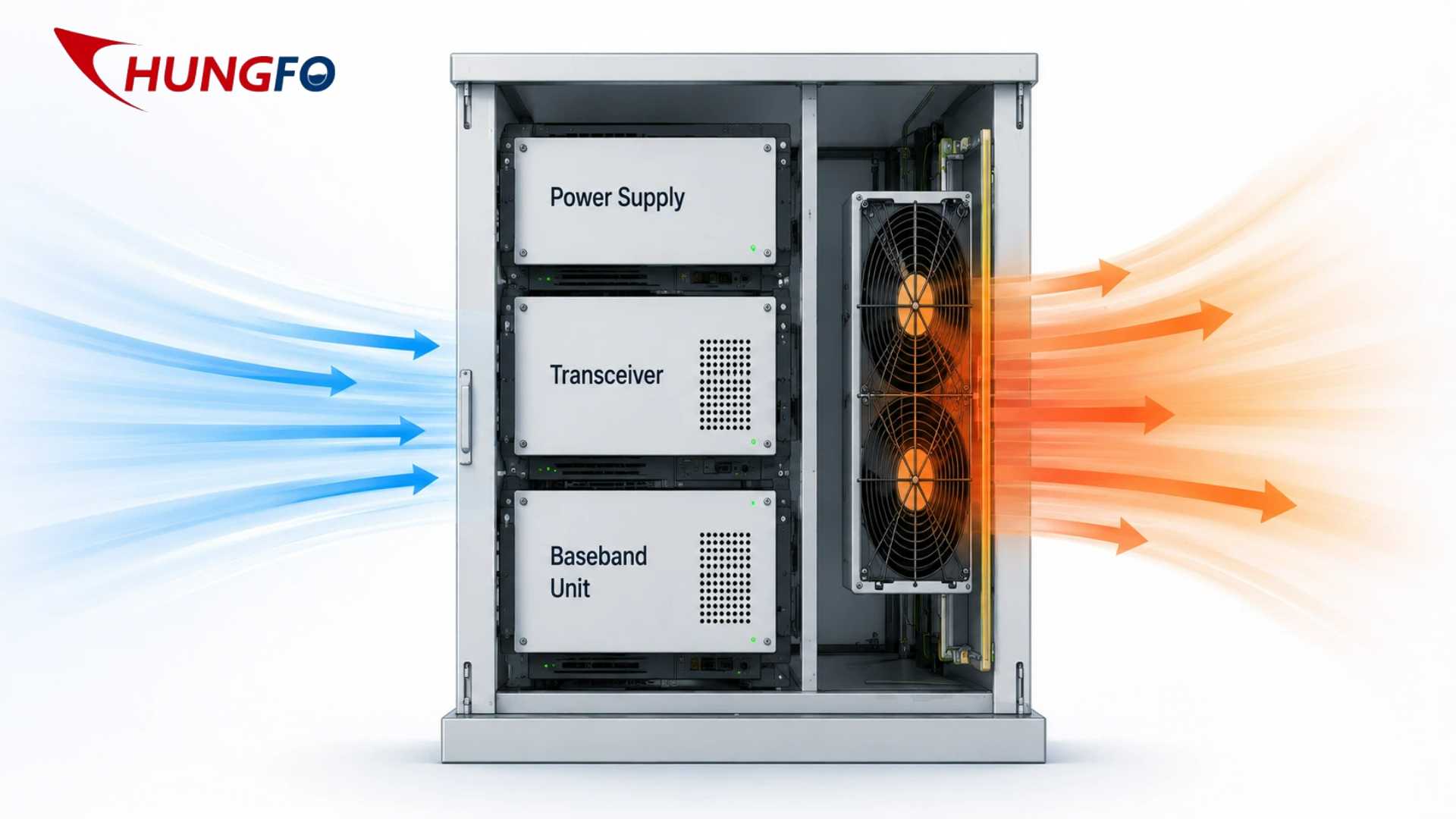
Die Hauptaufgabe eines Abluftventilators besteht darin, erwärmte Luft aus einem Gehäuse abzuführen und kühlere Luft durch dafür vorgesehene Öffnungen nachströmen zu lassen. Dadurch entsteht eine kontinuierliche erzwungene Konvektion, die verhindert, dass sich Wärme um elektronische Bauteile staut.
RPM bedeutet Umdrehungen pro Minute. Generell kann eine höhere Lüfterdrehzahl den Luftdurchsatz und den Druck erhöhen, wobei das genaue Verhältnis vom Lüfterdesign abhängt. Ein Lüfter mit höherer Drehzahl kann ein größeres Luftvolumen durch einen kompakten Raum bewegen und ist besonders vorteilhaft, wenn das Gehäuse Filter, Gitter, Kühlkörper, Kanäle oder andere Komponenten enthält, die den Luftstrom behindern.
Ein langsam laufender Ventilator kann beispielsweise im freien Betrieb für ausreichenden Luftstrom sorgen, seine Leistung kann jedoch erheblich sinken, sobald er hinter einem Schutzgitter oder Filter installiert ist. Ein leistungsstärkerer Ventilator kann den zusätzlichen Druck erzeugen, der erforderlich ist, um unter diesen realen Betriebsbedingungen einen ausreichenden Luftstrom aufrechtzuerhalten.
Aus diesem Grund sollten Ingenieure die Auswahl von Lüftern nicht allein auf Basis ihrer Luftdurchsatzwerte im Leerlauf treffen. Ein Lüfter, der bei statischem Druck von null einen hohen Luftdurchsatz liefert, bietet nach dem Einbau in einen realen Telekommunikationsschrank möglicherweise keine ausreichende Kühlleistung.
Das Verhältnis zwischen Luftstrom und Widerstand ist eines der wichtigsten Konzepte bei der Auswahl von Ventilatoren.
Warum ist der statische Druck für die Kühlung in der Telekommunikation wichtig?
Der statische Druck beschreibt die Fähigkeit des Lüfters, den Widerstand im Luftstrom zu überwinden. In einem Telekommunikationsschrank strömt die Luft selten durch eine vollständig offene Umgebung.
Die Luft muss unter Umständen ein Ansauggitter, einen Staubfilter, einen Kühlkörper, elektronische Module, ein Schutzgitter, enge Kanäle und eine Abluftöffnung passieren, bevor sie das Gehäuse verlässt. Jede dieser Komponenten kann zu Druckverlusten führen.
Mit steigendem Druckwiderstand sinkt der tatsächliche Luftdurchsatz eines Ventilators. Daher kann ein Ventilator mit hohem Freiluftdurchsatz in einem realen Gehäuse eine schlechte Leistung erbringen, wenn er nicht genügend Druck erzeugen kann.
Hier findet einHochleistungs-AbluftventilatorEine höhere Drehzahl kann von Vorteil sein. Sie kann dem Lüfter helfen, trotz höherem Systemwiderstand einen ausreichenden Luftstrom aufrechtzuerhalten. Ingenieure sollten jedoch stets die Leistungskurve des Lüfters analysieren und sich nicht allein auf die maximale Drehzahl oder den maximalen Luftstrom verlassen.
Eine gute Kühlungsplanung für Telekommunikationssysteme beginnt mit der Ermittlung des gesamten Systemluftstrombedarfs. Der Planer sollte die Wärmelast abschätzen, den zulässigen Temperaturanstieg bestimmen, den Luftwiderstand ermitteln und anschließend einen Lüfter auswählen, der am erforderlichen Betriebspunkt des Systems effektiv arbeitet.
Warum ist eine hohe Drehzahl in kompakten Telekommunikationsschränken von Vorteil?
Platz ist eine der größten Einschränkungen moderner Telekommunikationsgeräte. Kommunikationsgeräte werden immer kleiner, während ihre Rechenleistung stetig steigt. Das bedeutet, dass Ingenieure oft mehr Wärme aus einem kleineren Bauraum abführen müssen.
Ein größerer Ventilator kann potenziell mehr Luft bei niedrigerer Drehzahl bewegen, doch der verfügbare Platz für ein größeres Gehäuse reicht möglicherweise nicht aus. Ein kompakter Ventilator mit hoher Drehzahl kann eine praktische Alternative darstellen, wenn der Montagebereich begrenzt ist.
Dies ist insbesondere für kleine Kommunikationsschränke, Funkgeräte, Netzwerkgeräte und kompakte Außengehäuse relevant. In diesen Anwendungen kann eine Erhöhung der Lüfterdrehzahl dazu beitragen, die erforderliche Wärmeleistung zu erzielen, ohne die Abmessungen des Kühlsystems wesentlich zu vergrößern.
Hohe Drehzahlen sollten dennoch nicht als Standardlösung betrachtet werden. Höhere Drehzahlen können auch zu mehr Lärm, Vibrationen, Lagerbelastung und erhöhtem Energieverbrauch führen. Ziel sollte nicht die höchstmögliche Drehzahl erreicht werden, sondern der erforderliche Luftdurchsatz und -druck bei minimalem Energie- und Schallaufwand.
Die Rolle von Gleichstromlüftern in Telekommunikationsgeräten
AGleichstrom-LüfterDas Design ist für Telekommunikationsgeräte oft attraktiv, da viele Kommunikationssysteme bereits Gleichstromarchitekturen nutzen. Die Telekommunikationsinfrastruktur arbeitet üblicherweise mit dedizierten Gleichstromsystemen, wodurch Gleichstromlüfter sich bequem direkt integrieren lassen.
Ein Gleichstromlüfter kann auch Drehzahlregelung, Überwachung und thermisches Systemmanagement unterstützen. Je nach Ausführung können Steuersignale zur Überwachung der Lüfterdrehzahl oder zur Erkennung abnormaler Betriebszustände verwendet werden.
Für abgelegene Telekommunikationsanlagen ist diese Funktion äußerst wertvoll. Eine Basisstation kann sich in einem ländlichen Gebiet, auf einem Dach, neben einer Autobahn oder an einem anderen Ort befinden, wo eine regelmäßige manuelle Inspektion unpraktisch ist. Fällt ein Lüfter unerwartet aus, kann der daraus resultierende Temperaturanstieg die Kommunikationsgeräte beeinträchtigen.
Moderne Kühlsysteme in der Telekommunikation profitieren daher häufig von Lüftern, die Drehzahlrückmeldungen, Fehleralarme oder andere Überwachungsfunktionen bieten können.
Warum werden bürstenlose Gleichstrom-Axiallüfter so häufig eingesetzt?
Bürstenlose Axiallüfter für GleichstromSie eignen sich hervorragend für viele Telekommunikationskühlungsanwendungen, da sie kompakte Abmessungen, direkten Luftstrom und effiziente elektronische Kommutierung vereinen.
Im Gegensatz zu herkömmlichen Bürstenmotoren benötigen bürstenlose Motoren keine mechanischen Bürsten zur Kommutierung. Dadurch entfällt eine wichtige Quelle mechanischen Verschleißes, und die Technologie eignet sich für Anwendungen, die lange Dauerbetriebszeiten erfordern.
Ein Axialventilator fördert die Luft im Allgemeinen parallel zur Ventilatorwelle. Dadurch ist er besonders effektiv, wenn es darum geht, ein großes Luftvolumen durch einen Schrank oder einen Lüftungskanal zu bewegen.
Auch Telekommunikationsgeräte profitieren von der Steuerbarkeit bürstenloser Gleichstrommotoren. Die Lüfterdrehzahl lässt sich je nach Temperatur oder Gerätelast anpassen. Bei geringerem Wärmebedarf kann der Lüfter mit niedrigerer Drehzahl laufen. Steigt die Innentemperatur, erhöht die Steuerung die Lüfterdrehzahl, um die Kühlleistung zu steigern.
Mit diesem Ansatz lassen sich unnötiger Stromverbrauch und Geräusche reduzieren, während gleichzeitig die thermische Sicherheit gewährleistet wird.
Eine hohe Drehzahl bedeutet nicht, dass der Lüfter ständig mit maximaler Geschwindigkeit laufen muss. Ein gut ausgelegtes Steuerungssystem kann bei Bedarf hohe Drehzahlen bereitstellen und gleichzeitig einen Betrieb mit niedrigerer Drehzahl unter normalen Bedingungen ermöglichen.
Auswahl von Axiallüftern für Telekommunikationsschränke
Der Begriff Axialventilator wird manchmal im Zusammenhang mit Zwangslüftungslösungen sehr allgemein verwendet, Ingenieure sollten jedoch bei der Auswahl eines Produkts zwischen axialen und zentrifugalen Luftströmungseigenschaften unterscheiden.
Axialventilatoren werden im Allgemeinen bevorzugt, wenn ein hohes Luftvolumen durch einen relativ direkten Luftstrom strömen muss. Radialventilatoren eignen sich besser, wenn das System einen höheren Druck erfordert und der Luftstrom durch Kanäle oder enge Durchgänge geleitet werden muss.
Bei einem Telekommunikationsschrank hängt die richtige Wahl von der Gehäusekonstruktion, der Druckbeständigkeit und der Kühlarchitektur ab.
Bei großen Lüftungsöffnungen und einem relativ offenen Luftstrom im Gehäuse kann ein Axialventilator eine effiziente Lösung darstellen. Muss die Luft hingegen einen dichten Wärmetauscher, einen engen Kanal oder ein komplexes Kanalsystem passieren, ist ein Hochdruckventilator oder ein Gebläse möglicherweise besser geeignet.
Diese Unterscheidung ist wichtig, da die Wahl des falschen Lüftertyps zu einer enttäuschenden Kühlleistung führen kann, selbst wenn der Nennluftstrom ausreichend erscheint.
Hohe Drehzahl und hohe Wärmeableitungseffizienz
Die Wärmeabfuhr aus einem Gehäuse lässt sich durch den grundlegenden Zusammenhang zwischen Wärmelast, Luftstrom und Temperaturanstieg erklären.
Wenn ein System eine bestimmte Wärmemenge erzeugt, kann durch Erhöhung der durch das Gehäuse strömenden Luftmenge im Allgemeinen der Temperaturanstieg zwischen Einlass- und Auslassluft verringert werden, vorausgesetzt, die einströmende Luft ist ausreichend kühler als die Innenluft.
Dies bedeutet, dass eine hohe Drehzahl von Vorteil sein kann, wenn ein zusätzlicher Luftstrom zur Bewältigung einer hohen thermischen Belastung erforderlich ist.
However, thermal performance depends on more than airflow quantity. The location of the inlet, the position of heat-generating components, the direction of fan rotation, the exhaust location and the internal structure of the cabinet all affect the actual cooling result.
If the fan creates airflow that bypasses the hottest components, the theoretical airflow rating may not translate into effective component cooling.
This is why airflow organization is as important as fan performance.
The Importance Of Airflow Direction
A successful telecom cooling system should establish a clear airflow path.
Cool air should enter from an appropriate location, pass across the heat-generating components and then leave the cabinet through an exhaust path. The airflow should not circulate unnecessarily inside the enclosure.
An exhaust fan mounted at the correct position can create negative pressure inside the cabinet and encourage air to move through the intended path.
For example, if hot air naturally accumulates near the upper part of the cabinet, an exhaust fan installed near the upper outlet can help remove that accumulated heat. At the same time, an intake opening should be positioned to provide cooler air to the equipment.
The exact configuration depends on cabinet geometry and component arrangement.
Why 5G Makes Cooling More Challenging
5G communication equipment introduces additional thermal management challenges because the infrastructure is designed for high data throughput, low latency and dense deployment.
Research has shown that increasing power density and energy consumption in 5G base stations make thermal performance and energy efficiency increasingly important. Hybrid cooling systems and cabinet-level thermal management have therefore become active areas of engineering research.
In practical applications, the cooling system must work continuously while maintaining equipment temperature under changing outdoor conditions.
An outdoor cabinet can experience high solar radiation, high ambient temperature, humidity, rain, dust and salt exposure. These factors place additional demands on the fan.
A fan that performs well in a laboratory may not necessarily provide the same reliability in a coastal outdoor cabinet.
Environmental Requirements For Telecom Exhaust Fans
Outdoor telecom equipment may operate under a wide range of environmental conditions. Temperature, humidity, dust, water, salt spray and vibration can all affect fan performance.
For outdoor applications, designers should therefore consider the appropriate protection structure, corrosion resistance, bearing technology and material selection.
The fan housing and impeller must maintain mechanical integrity under temperature changes. Bearings must be capable of supporting long continuous operation. Electronic components should be designed for the expected voltage and temperature range.
In coastal environments, salt and moisture can accelerate corrosion. In dusty environments, filters may become blocked and increase airflow resistance. This can cause the fan operating point to move toward a lower airflow condition.
A reliable telecom cooling system should therefore consider the fan and the entire ventilation system as one integrated design.
Fan Reliability Is As Important As Fan Speed
Telecom infrastructure is often expected to operate continuously for years. A fan that delivers excellent airflow but fails prematurely is not a reliable cooling solution.
Bearing selection is one important factor. Ball bearings are commonly considered for applications requiring long service life and wide operating conditions, while sleeve bearing designs may be suitable for certain cost-sensitive or controlled environments.
Motor quality, winding design, electronic commutation, impeller balance and manufacturing consistency also affect service life.
Dynamic balancing is particularly important for high RPM fans. As rotational speed increases, imbalance can create greater vibration and mechanical stress. A properly balanced impeller helps reduce vibration and improves overall operating stability.
This is why high RPM fan manufacturing requires careful control of mechanical tolerances and production quality.
Noise And High RPM
One disadvantage of high RPM operation is increased noise.
Telecom equipment may be installed near offices, residential areas, transportation infrastructure or other locations where acoustic performance matters. A fan running continuously at maximum speed can generate unnecessary noise if the thermal load is actually low.
The solution is not necessarily to avoid high RPM fans. Instead, the system can use intelligent speed control.
Temperature sensors can monitor the internal environment and adjust fan speed according to thermal demand. When the cabinet is cool, the fan can operate at a lower speed. When temperature increases, the controller can increase RPM.
This provides a balance between cooling capacity, energy consumption and noise.
Energy Efficiency In Base Station Cooling
Cooling can represent a significant part of the overall energy consumption of communication infrastructure. Therefore, thermal management must balance reliability with energy efficiency.
A fan that operates at unnecessarily high speed consumes more energy than required. On the other hand, reducing fan speed too much can increase internal temperature and compromise equipment reliability.
Recent research into 5G base station cooling has focused on optimizing cooling operation and fan speed to reduce energy consumption while maintaining thermal requirements.
This supports an important engineering principle: the best fan is not necessarily the fan with the highest RPM. The best fan is the fan that provides sufficient cooling performance under the real operating conditions while maintaining acceptable energy consumption and reliability.
Fan Redundancy For Critical Telecom Equipment
Because communication networks are critical infrastructure, redundancy can be an important part of cooling system design.
If one cooling fan fails, another fan may continue to provide sufficient airflow until maintenance can be performed. In higher-reliability systems, multiple fans can operate together so that the system retains cooling capacity even after one fan experiences a fault.
This is commonly described through configurations such as N plus 1 redundancy.
Fan monitoring can further improve reliability. Speed feedback can help detect a stalled or degraded fan, while alarm signals can notify the control system when abnormal conditions occur.
For remote base stations, this type of monitoring can reduce maintenance response time and help prevent thermal failures.
How To Select A High RPM Exhaust Fan For A Base Station
The selection process should begin with the thermal load rather than the fan itself.
First, determine the amount of heat generated by the equipment. Next, identify the maximum allowable internal temperature and the expected ambient temperature. Then calculate the required airflow and evaluate the pressure losses created by filters, grilles, heat sinks and enclosure structures.
After that, compare fan performance curves.
Engineers should evaluate airflow at the actual static pressure rather than relying on the free-air airflow value. Rated voltage, operating voltage range, RPM, power consumption, noise, bearing type, operating temperature and expected service life should also be considered.
For outdoor telecom cabinets, environmental protection and corrosion resistance should be included in the selection criteria.
The fan should also be evaluated for control and monitoring functions. Depending on the system, PWM control, FG speed feedback, RD alarm output or other customized signals may be required.
Why Manufacturing Quality Matters
The performance of a telecom cooling fan depends heavily on manufacturing consistency.
High speed rotation requires accurate impeller geometry, balanced components, reliable bearings and stable motor performance. Small manufacturing deviations can influence vibration, noise, airflow and service life.
A professional fan manufacturer should therefore have appropriate testing capabilities for airflow, pressure, noise, vibration, temperature and reliability.
Quality control should extend from motor components and electronic control boards to impeller molding, assembly and final testing.
For OEM and ODM telecom projects, customized voltage, connector, cable length, alarm signal and mounting dimensions may also be required.
Chungfo provides cooling fan solutions for different electronic and industrial applications, with capabilities covering product design, injection molding, SMT production and fan assembly. The company can support customers who need customized cooling fan solutions for equipment requiring stable airflow and long-term operation.
The Future Of Telecom Base Station Cooling
The future of telecom cooling will increasingly focus on intelligent control, energy efficiency and system integration.
Instead of operating cooling fans continuously at a fixed speed, modern systems can adjust airflow according to equipment temperature, workload and environmental conditions.
Sensor-based control can reduce energy consumption during low-load periods while providing rapid cooling when thermal demand increases.
At the same time, the increasing deployment of edge computing, high-density communication equipment and distributed 5G infrastructure will continue to create demand for compact and reliable cooling technologies.
Fan technology will therefore remain an important part of telecom thermal management even as heat pipes, liquid cooling, heat exchangers and other advanced technologies become more common.
In many applications, the most practical solution will combine multiple technologies. A fan may work with a heat sink, heat pipe, heat exchanger or air conditioning system to improve the overall thermal performance.
Conclusion
Telecom base stations require effective thermal management because communication equipment generates heat continuously while often operating in compact and difficult environments.
A high RPM exhaust fan can provide strong airflow in a limited installation space and can help overcome airflow resistance created by filters, grilles, heat sinks and dense electronic components.
However, RPM should never be the only selection criterion. Airflow, static pressure, airflow direction, fan size, voltage, bearing type, environmental protection, noise, energy consumption and monitoring functions must all be evaluated together.
For 5G and other high-density communication systems, the importance of thermal management will continue to increase. A properly selected DC brushless fan can provide controllable, reliable airflow, while an appropriate axial ventilation design can remove heat efficiently from the cabinet.
The most effective telecom cooling system is therefore not simply the system with the fastest fan. It is the system that creates the correct airflow path, provides sufficient cooling capacity, operates reliably for long periods and uses energy efficiently.
For telecom equipment manufacturers, system integrators and engineering companies, selecting the right high RPM exhaust fan at the design stage can significantly improve equipment reliability and help reduce the risk of thermal-related failures.
FAQ
What RPM should a telecom base station exhaust fan have?
There is no universal RPM value for every telecom base station. The correct speed depends on heat load, cabinet size, airflow resistance, fan dimensions and allowable temperature rise. A fan should be selected according to its performance at the required system pressure rather than RPM alone.
Why are high RPM fans useful in telecom cabinets?
High RPM fans can provide strong airflow and pressure from relatively compact fan dimensions. This makes them useful when the available installation space is limited or when the airflow path contains significant resistance.
Are DC fans suitable for telecom base stations?
Yes. DC fans are widely suitable for communication equipment because many telecom systems use DC power architectures. DC fan designs can also support speed control, monitoring and customized control signals.
Are brushless fans better for telecom applications?
Brushless motor technology is often well suited to telecom applications because it eliminates mechanical brush wear and can provide reliable continuous operation. The final choice should still consider bearing design, operating temperature, electrical specifications and required service life.
Is a high airflow rating enough when choosing a telecom fan?
No. Free-air airflow does not represent the actual airflow after the fan is installed in a cabinet. Static pressure and the complete system resistance must also be considered.
Why is static pressure important for base station cooling?
Filters, grilles, heat sinks, ducts and densely packed components can restrict airflow. A fan with adequate static pressure can maintain useful airflow under these conditions.
Should a telecom fan run at maximum RPM continuously?
Not necessarily. Temperature-based or PWM speed control can allow the fan to operate at lower speed when cooling demand is low and increase speed when the cabinet temperature rises.
What type of fan is commonly used for telecom cabinet ventilation?
Axial fans are commonly used where the system requires large airflow through a relatively direct ventilation path. Centrifugal blowers may be more appropriate when higher pressure or more complicated airflow routing is required.
What environmental factors should be considered for outdoor telecom fans?
Engineers should consider ambient temperature, humidity, dust, water exposure, salt spray, vibration and corrosion. The fan should be selected according to the actual outdoor environment.
Why is fan redundancy important in telecom systems?
Kommunikationsinfrastrukturen erfordern häufig eine hohe Verfügbarkeit. Redundante Lüfter können die Kühlleistung aufrechterhalten, falls ein Lüfter ausfällt, und das Risiko einer Geräteüberhitzung vor Wartungsarbeiten verringern.
Wie kann der Energieverbrauch von Kühlventilatoren in der Telekommunikation reduziert werden?
Die Lüfterdrehzahl kann dem Wärmebedarf angepasst werden, anstatt den Lüfter dauerhaft mit maximaler Drehzahl laufen zu lassen. Eine optimierte Luftstromführung, Filter mit geringem Widerstand und die Auswahl effizienter Lüfter können die Kühlleistung ebenfalls verbessern.
Welche Angaben sollten Ingenieure bei der Anforderung eines kundenspezifischen Telekommunikationslüfters machen?
Wichtige Informationen umfassen Lüfterabmessungen, Spannung, erforderlichen Luftdurchsatz, statischen Druck, Betriebstemperatur, Installationsumgebung, Anschlussanforderungen, Kabellänge, Steuerungsmethode und Überwachungssignale. Die Angabe dieser Details ermöglicht es dem Hersteller, eine besser geeignete Lösung zu empfehlen.