
Kategorien
Neuer Blog
Was verursacht das Pumpen bei kleinen Radialgebläsen und wie können Ingenieure instabilen Luftstrom verhindern?
August 31 , 2026Kleine Radialgebläse finden breite Anwendung in Elektronikgeräten, Medizintechnik, Haushaltsgeräten, Kühlsystemen, Batterieanlagen, Ladegeräten, Schaltschränken, Lüftungsanlagen und anderen kompakten Systemen. Da diese Gebläse oft auf engstem Raum installiert werden, müssen Ingenieure häufig Luftstrom, statischen Druck, Geräuschentwicklung, Stromverbrauch, Abmessungen und Zuverlässigkeit optimal aufeinander abstimmen.
In vielen Anwendungsfällen erscheint die Auswahl eines kleinen Gebläses unkompliziert. Ein Ingenieur vergleicht den benötigten Luftdurchsatz mit dem maximalen Luftdurchsatz im Datenblatt und wählt ein Modell mit ausreichender Kapazität. Die tatsächliche Leistung kann jedoch nach dem Einbau des Gebläses in ein komplettes Anlagensystem erheblich abweichen.
Der Grund ist einfach: Ein Gebläse funktioniert nicht unabhängig.
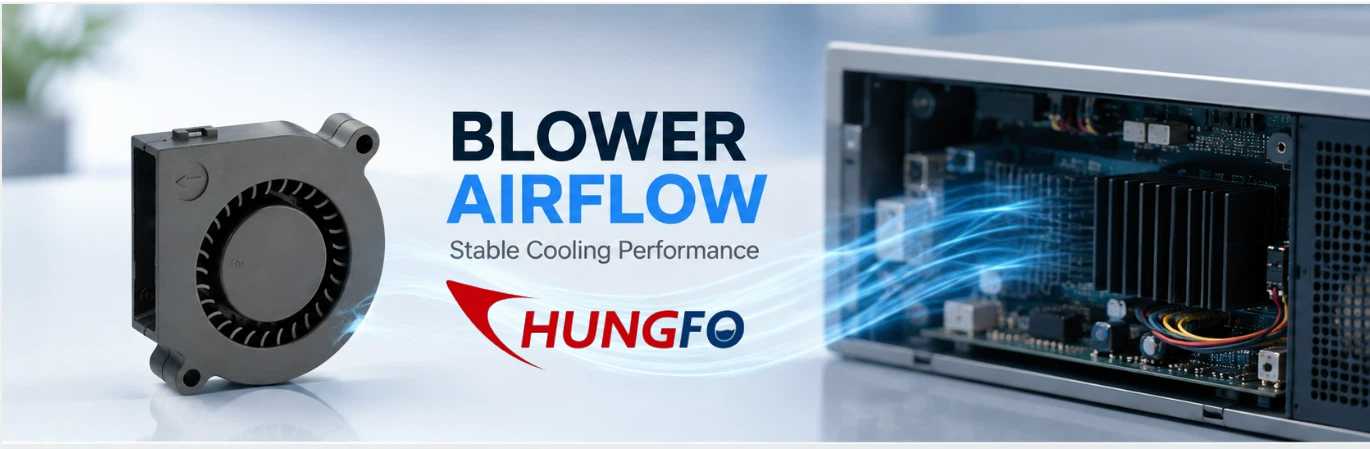
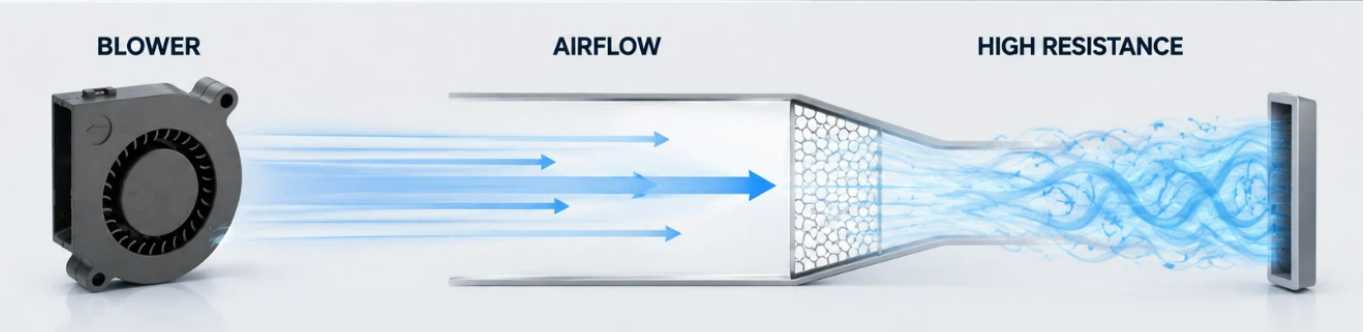
Das Gebläse muss den Widerstand überwinden, der durch Luftkanäle, Filter, Kühlkörper, Lüftungsöffnungen, Gitter, Krümmungen, enge Durchgänge, Wärmetauscher und andere Bauteile entsteht. Wird dieser Widerstand zu hoch, entfernt sich der Betriebspunkt des Gebläses von seinem optimalen Bereich. Der Luftstrom kann deutlich abnehmen, der Druck kann schwanken und es können ungewöhnliche Geräusche oder Vibrationen auftreten.
Unter bestimmten Bedingungen kann die Wechselwirkung zwischen dem Gebläse und dem angeschlossenen Luftstromsystem einen instabilen Betriebszustand hervorrufen, der gemeinhin als Gebläse-Pumpen oder Strömungsinstabilität bezeichnet wird.
Bei großen industriellen Zentrifugalmaschinen kann das Pumpen ein gravierendes aerodynamisches Phänomen mit starken Druck- und Volumenstromschwankungen darstellen. Bei kleinen Radialgebläsen in kompakten Anlagen ist die Situation oft weniger dramatisch. Ingenieure stoßen eher auf hohen Systemwiderstand, signifikante Volumenstromreduzierung, Druckschwankungen, pulsierende Geräusche oder instabile Strömung, bevor sie das für große Industrieanlagen typische starke Pumpenverhalten erleben.
Das Verständnis dieses Unterschieds ist wichtig bei der Konstruktion von Geräten mit kleinen Gebläsen.
Dieser Artikel erklärt, was Gebläseschwingungen im Zusammenhang mit kleinen Radialgebläsen bedeuten, warum ein übermäßiger Systemwiderstand zu instabilem Luftstrom führen kann, wie Ingenieure potenzielle Probleme erkennen können und wie die richtige Gebläseauswahl und die Gestaltung des Luftstromwegs das Risiko verringern können.
Was ist ein Gebläse-Pumpen?
Unter Gebläse-Surging versteht man einen instabilen aerodynamischen Zustand, bei dem der vom Gebläse erzeugte Luftstrom und Druck schwanken, anstatt relativ stabil zu bleiben.
Das Phänomen steht in engem Zusammenhang mit dem Verhältnis zwischen Gebläseleistung und Systemwiderstand.
Jeder Radialventilator besitzt eine Kennlinie. Diese Kennlinie zeigt üblicherweise, wie sich der Luftstrom bei Änderung des statischen Drucks verändert. Bei geringem Systemwiderstand kann der Ventilator in der Regel einen relativ hohen Luftstrom liefern. Mit steigendem Systemwiderstand sinkt der Luftstrom, während der Ventilator mit höherem Druck arbeitet.
Ein komplettes Anlagensystem besitzt ebenfalls eigene Widerstandseigenschaften.
Stellen Sie sich beispielsweise ein kleines Gebläse vor, das in einem elektronischen Gerät eingebaut ist. Die Luft strömt durch ein Einlassgitter ein, durchströmt das Gebläse, gelangt durch einen schmalen internen Kanal, passiert einen Kühlkörper und tritt durch eine kleine Lüftungsöffnung aus.
Jedes Teil erzeugt Widerstand.
Bei relativ freiem Luftstrom kann das Gebläse mit angemessener Luftmenge stabil arbeiten.
Wenn der Auslass verengt wird, erhöht sich der Systemwiderstand.
Wenn ein Filter verschmutzt wird, steigt der Widerstand wieder an.
Wenn der Kühlkörper mit Staub verunreinigt wird, kann sich der Widerstand weiter erhöhen.
Schließlich kann es passieren, dass das Gebläse in einen Bereich seines Betriebsbereichs gezwungen wird, in dem der Luftstrom sehr gering wird und das aerodynamische Verhalten instabiler wird.
Je nach Gebläsekonstruktion und Systemkonfiguration kann dies zu Luftstrompulsationen, Druckschwankungen, Geräuschschwankungen, Vibrationen oder anderen instabilen Verhaltensweisen führen.
Daher sollten Ingenieure das Pulsieren des Gebläses nicht einfach als ein Problem innerhalb des Gebläsemotors betrachten.
Es ist üblicherweise das Ergebnis der Wechselwirkung zwischen dem Gebläse und dem gesamten Luftstromsystem.
Ist ein Drehzahlanstieg bei kleinen Gebläsen üblich?
Dies ist eine wichtige Frage für Geräteentwickler.
Bei kleinen Radialgebläsen kann es zu aerodynamischer Instabilität kommen, doch sollten Ingenieure vorsichtig sein, wenn sie den Begriff „Pumpen“ auf Anwendungen mit kompakten Gebläsen anwenden.
Große industrielle Zentrifugalkompressoren und große Prozessgebläse können starken Pumpvorgängen ausgesetzt sein, die mit erheblichen Strömungsumkehrungen und Druckschwankungen einhergehen. Kleine Gleichstromgebläse, die zur Kühlung von Elektronikgeräten oder Haushaltsgeräten eingesetzt werden, arbeiten im Allgemeinen mit deutlich geringeren Fördermengen und kleineren Systemvolumina.
Daher sind die Symptome oft unterschiedlich.
Ein kleines Gebläse kann folgende Probleme aufweisen:
Reduzierter Luftdurchsatz
Höherer statischer Druck
Pulsierender Luftstrom
Änderung des aerodynamischen Lärms
Erhöhte Vibration
Schwankende Motorlast
Verminderte Kühlleistung
Diese Zustände können durch einen übermäßigen Systemwiderstand verursacht werden, selbst wenn es sich nicht um eine starke Überspannung im klassischen industriellen Sinne handelt.
Für die Kommunikation im Marketing und in der Technik ist es daher genauer zu erklären, dass kleine Radialgebläse unter ungünstigen Systembedingungen mit instabiler Luftströmung oder stoßartigem Verhalten konfrontiert werden können.
Diese Unterscheidung verleiht der technischen Diskussion mehr Glaubwürdigkeit.
Es hilft den Kunden auch zu verstehen, dass es bei der Auswahl eines Gebläses nicht einfach darum geht, ein Produkt mit der höchsten Luftdurchsatzrate zu finden.
Warum Systemwiderstand so wichtig ist
Der Systemwiderstand ist einer der wichtigsten Faktoren, die die tatsächliche Leistung eines kleinen Radialgebläses beeinflussen.
In den Spezifikationen eines Gebläses kann ein maximaler Luftdurchsatz angegeben sein. Dieser maximale Luftdurchsatz wird jedoch in der Regel unter bestimmten Testbedingungen gemessen und kann auftreten, wenn das Gebläse auf einen sehr geringen Widerstand trifft.
Die reale Ausrüstung ist anders.
Sobald das Gebläse installiert ist, muss die Luft den gesamten Luftstromweg durchlaufen.
Ein Filter erzeugt Widerstand.
Ein Gitter erzeugt Widerstand.
Ein Kühlkörper erzeugt Widerstand.
Ein enger Kanal erzeugt Widerstand.
Ein langer Kanal erzeugt Widerstand.
Eine scharfe Biegung erzeugt Widerstand.
Eine kleine Auslassöffnung erzeugt Widerstand.
Die kombinierte Wirkung kann erheblich sein.
Aus diesem Grund sollten Ingenieure das Verhältnis von Luftstrom und statischem Druck betrachten, anstatt nur den maximalen Luftstrom zu berücksichtigen.
Beispielsweise kann ein Gebläse, das mit einem hohen Freiluft-Luftdurchsatz beworben wird, bei Anschluss an eine dichte Kühlstruktur einen deutlich geringeren Luftdurchsatz liefern.
Dies ist besonders wichtig bei kompakten Geräten, da die Konstrukteure oft nur begrenzten Platz für Luftkanäle haben.
Wenn der verfügbare Luftstromweg kleiner wird, kann der Druckabfall rapide ansteigen.
Wird der Systemwiderstand zu hoch, verbringt das Gebläse möglicherweise den größten Teil seiner Betriebszeit im Bereich niedriger Luftmengen und hohen Drucks.
Dies kann die Kühlleistung verringern und zu instabilem aerodynamischem Verhalten führen.
Der Unterschied zwischen freier Luftströmung und realer Betriebsströmung
Einer der häufigsten Fehler bei der Auswahl von Gebläsen ist der Vergleich von reinen Freiluft-Luftstromwerten.
Freie Luftströmung beschreibt einen Zustand mit minimalem äußeren Widerstand.
Tatsächliche Geräte arbeiten fast nie unter völlig uneingeschränkten Bedingungen.
Betrachten wir eine Kühlanwendung, bei der ein Gebläse verwendet wird, um Luft über einen Kühlkörper zu drücken.
Bei eng beieinander liegenden Kühlrippen kann der Luftwiderstand erheblich sein.
Nun fügen Sie einen Staubfilter hinzu.
Fügen Sie dann einen schmalen Auslass hinzu.
Fügen Sie anschließend zwei Biegungen im Luftkanal hinzu.
Der endgültige Systemwiderstand kann wesentlich höher sein als in der ursprünglichen Berechnung angenommen.
Das Gebläse muss all diese Druckverluste ausgleichen.
Folglich kann der tatsächliche Luftstrom viel geringer sein als der unter Freiluftbedingungen angegebene Wert.
Deshalb sollte bei der Auswahl professioneller Gebläse stets der zu erwartende Systemdruck berücksichtigt werden.
Was verursacht instabile Luftströmung in kleinen Radialgebläsen?
Mehrere Faktoren können zu einer instabilen Luftströmung beitragen.
Das erste Problem ist eine übermäßige Einschränkung der Ausgabemöglichkeiten.
Ist die Auslassöffnung zu klein, muss das Gebläse einen höheren Druck erzeugen, um die Luft durch das System zu befördern.
Das zweite Problem ist ein zu kleiner Luftkanal.
Ein enger Durchgang erhöht die Luftgeschwindigkeit und den Druckverlust.
Der dritte Grund ist ein zu hoher Filterwiderstand.
Die Filterleistung wird noch weiter eingeschränkt, wenn sich Staub ansammelt.
Der vierte Grund ist eine mangelhafte Einlasskonstruktion.
A blower needs a suitable air supply. If the inlet is partially blocked or airflow enters the impeller unevenly, aerodynamic performance may deteriorate.
The fifth is excessive duct bending.
Sharp bends close to the blower can create turbulence and uneven velocity distribution.
The sixth is improper blower selection.
A blower that is too small may not have sufficient pressure capability for the application.
A blower that is too large may create excessive pressure and force the system to use restrictive control methods.
The seventh is changing operating conditions.
A system may work well during initial testing but become less stable after filters become dirty or when equipment configuration changes.
Why Small Blower Size Does Not Mean Simple Airflow Design
Because small blowers occupy very little physical space, designers sometimes assume that airflow design is also simple.
In reality, compact systems can be more challenging.
A large industrial ventilation system may have sufficient space for smooth ducts, gradual transitions, large filters, and appropriately sized outlets.
A compact electronic device may have only a few centimeters of available space.
The designer may need to route air around circuit boards, heat sinks, batteries, cables, brackets, and structural components.
This creates many local restrictions.
A blower may have excellent performance when tested alone, but the same blower can perform very differently after installation.
Therefore, compact blower applications require careful attention to the complete airflow path.
How To Recognize Potential Blower Instability
Engineers and maintenance personnel can look for several warning signs.
The first is unusual airflow fluctuation.
If the equipment operates under a stable thermal load but airflow repeatedly changes, the airflow path should be inspected.
The second is pressure fluctuation.
A pressure sensor can help identify changes in system pressure that may not be obvious from airflow measurements alone.
The third is unusual noise.
A small blower operating normally should produce relatively consistent aerodynamic noise. Pulsating or changing noise can indicate turbulence, excessive restriction, or unstable airflow.
The fourth is increased vibration.
Aerodynamic instability can create changing forces on the impeller and housing.
The fifth is reduced cooling performance.
If electronic components become hotter even though blower speed has not changed, system resistance or airflow restriction may have increased.
The sixth is changing motor current.
Changes in aerodynamic loading can affect the electrical load of the motor.
These symptoms should be evaluated together rather than individually.
Does Higher RPM Always Solve The Problem?
Increasing blower speed can increase airflow and pressure, but it should not automatically be treated as the solution.
Suppose a filter is becoming blocked.
The equipment begins to experience reduced airflow.
An operator increases blower speed.
Airflow improves temporarily.
However, the filter remains blocked.
The blower now operates at a higher speed and may consume more power while generating higher pressure.
If the system resistance continues increasing, the operating condition may eventually become unfavorable again.
Therefore, higher speed can compensate for some operating changes, but it cannot replace proper airflow-path design and maintenance.
Engineers should always determine why airflow is declining before simply increasing speed.
Selecting The Right Blower Performance
For small centrifugal blowers, the most important selection information includes airflow, static pressure, operating voltage, speed, noise, dimensions, power consumption, operating temperature, and expected service life.
Among these parameters, the airflow-pressure relationship is particularly important.
The required operating point should be identified first.
For example, if the equipment requires a certain airflow while overcoming a defined static pressure, the selected blower should be able to provide that combination under the actual operating conditions.
This is much more meaningful than selecting a blower simply because its maximum airflow is higher than the required value.
Engineers should also consider the operating range.
If the equipment can experience changes in filter condition, temperature, valve position, or airflow demand, the blower should maintain acceptable performance across those conditions.
40mm Blower FanApplications And Airflow Stability
A 40mm blower fan is typically associated with compact equipment where installation space is limited.
Such small blowers can be useful for localized cooling inside electronic devices, control systems, instruments, communication equipment, and other compact assemblies.
However, their small size means that the airflow path can have a relatively large influence on total system resistance.
A small outlet that appears acceptable visually may represent a significant restriction relative to the blower's available airflow area.
Likewise, a narrow internal channel may consume a large portion of the available pressure.
Therefore, when designing a system around a 40mm blower fan, engineers should evaluate the complete airflow path rather than only the blower itself.
The inlet area, outlet area, duct length, bends, filters, and heat dissipation components should all be considered.
100mm Blower FanApplications
A 100mm blower fan provides more installation flexibility than extremely compact blowers in some applications and may be selected when greater airflow or pressure capability is required.
However, larger physical size does not automatically eliminate airflow instability.
A 100mm blower fan can still operate under excessive system resistance if the connected duct, filter, heat exchanger, or outlet is improperly designed.
The same selection principle therefore applies.
Engineers should match the blower to the actual system operating point.
The objective is stable airflow rather than simply maximum airflow.
Blower 5015And Compact Cooling Design
A blower 5015 is an example of the type of compact blower format that can be considered for space-constrained cooling applications.
When using compact blowers of this type, designers should pay particular attention to the relationship between blower dimensions and airflow-path dimensions.
A compact blower may fit easily into the equipment, but the surrounding structure can still restrict airflow.
For example, placing the blower directly against a narrow wall or mounting bracket may reduce the effective inlet area.
Similarly, connecting the outlet to a narrow passage may increase pressure loss.
These details can influence actual performance more than the nominal blower dimensions suggest.
How Inlet Design Affects Blower Performance
The blower inlet is often overlooked.
Air should be able to enter the blower smoothly and reasonably uniformly.
If the inlet opening is partially blocked, the blower may have to operate with an uneven velocity distribution.
A sharp bend immediately before the inlet can also create turbulence.
In compact equipment, engineers may need to position the blower close to other components because of space limitations.
However, leaving adequate inlet clearance can improve airflow quality.
The inlet grille should also provide sufficient open area.
A decorative grille may look attractive but create unnecessary pressure loss if its open area is too small.
How Outlet Design Affects System Resistance
The outlet is equally important.
A blower may generate sufficient pressure, but if the outlet cannot pass the required airflow, system resistance will increase.
The outlet should be appropriately sized.
Sudden contractions should be avoided where possible.
Sharp changes in direction should be minimized.
If a protective grille is required, its open area should be evaluated.
If a filter is installed at the outlet, its pressure drop should be included in the system calculation.
These small design decisions can have a significant effect on the final operating point.
Filters And Their Impact On Blower Operation
Filters are important for protecting equipment from dust, but they inevitably create pressure loss.
A new filter may have relatively low resistance.
After extended operation, dust accumulation can increase pressure drop.
This means the blower operating point can gradually change over time.
A cooling system that performed well during initial testing may therefore deliver less airflow several months later.
For equipment requiring stable thermal performance, filter condition should be included in the maintenance plan.
Engineers should also specify the acceptable filter pressure drop rather than treating filtration as an isolated component.
Heat Sinks Can Also Create Significant Resistance
Heat sinks are widely used in electronic cooling systems.
While a heat sink improves heat transfer, closely spaced fins can restrict airflow.
If the blower must force air through a dense fin structure, static pressure requirements increase.
The thermal engineer should therefore consider both heat transfer and pressure loss.
A heat sink with extremely dense fins may provide a large heat transfer surface but require more blower pressure.
A slightly different fin spacing may reduce pressure loss while still providing adequate thermal performance.
The best solution is usually a balance between thermal performance and airflow resistance.
The Importance Of System Testing
Calculations are important, but prototype testing is often necessary.
A small blower should ideally be tested inside the actual or representative equipment.
Testing should measure airflow, pressure, temperature, noise, vibration, and motor electrical parameters where appropriate.
The equipment should be tested under different thermal loads.
Minimum, normal, and maximum operating conditions should be evaluated.
If the system uses a filter, test both clean and representative loaded conditions when practical.
If the blower uses speed control, the complete control range should also be tested.
This approach allows engineers to identify problems before mass production.
How Engineers Can Reduce Surge Risk
The first step is to reduce unnecessary system resistance.
Use appropriately sized airflow channels.
Avoid unnecessary bends.
Provide adequate inlet and outlet areas.
Select filters with suitable pressure-drop characteristics.
Avoid excessive restrictions around heat sinks.
Choose the blower based on the actual airflow-pressure requirement.
Provide sufficient operating margin.
Use appropriate speed control when necessary.
Monitor system performance during operation.
Maintain filters and airflow paths.
These measures can significantly improve airflow stability.
Should Engineers Choose A Higher Pressure Blower?
Sometimes a higher pressure blower is appropriate.
If the system contains dense heat sinks, long ducts, filters, or other restrictive components, the blower needs enough pressure capability to maintain the required airflow.
However, selecting the highest pressure blower available is not always the best solution.
The blower should be matched to the system.
Too little pressure capability results in insufficient airflow.
Excessive pressure capability may increase noise, power consumption, and the need for restrictive control.
The correct solution is the blower that can provide the required airflow at the required static pressure while operating within a suitable region of its performance curve.
How Speed Control Can Help
Speed control can help compensate for changes in cooling demand.
When thermal load increases, blower speed can be increased within the permitted operating range.
When thermal load decreases, speed can be reduced.
This can improve energy efficiency and reduce unnecessary noise.
However, the control system should have defined operating limits.
It should not continuously command the blower into an unstable region.
For critical equipment, pressure or airflow feedback can be used to improve control accuracy.
The Role Of Motor And Impeller Design
Although system resistance is extremely important, blower construction also influences stability.
Impeller geometry determines how air is accelerated and pressurized.
Housing geometry affects the airflow path.
Motor speed affects pressure and airflow capability.
Impeller balance affects vibration.
Bearing quality influences mechanical reliability.
Material selection affects temperature resistance and structural stability.
Therefore, engineers should consider both aerodynamic performance and mechanical design when evaluating a blower.
Why Noise Can Be An Early Warning Sign
Noise is often one of the first things that users notice.
A change in sound may indicate increased turbulence or unstable airflow.
For compact equipment, noise is particularly important because users may be close to the product.
If a blower becomes noticeably louder after installation, engineers should check whether the airflow path is causing excessive pressure loss.
The noise may not be caused by the blower itself.
A narrow outlet, grille, duct bend, or turbulent transition can create significant additional aerodynamic noise.
Why Vibration Should Not Be Ignored
Vibration in a small blower can have several causes.
Mechanical imbalance is one possibility.
Bearing problems are another.
Improper mounting can also increase vibration.
However, aerodynamic instability should also be considered.
If vibration increases together with airflow fluctuation and changing noise, the system should be evaluated as a whole.
Replacing the blower without correcting the airflow restriction may not solve the problem.
Designing For Long-Term Reliability
A blower that performs well on the first day should continue performing well months or years later.
Long-term reliability requires consideration of dust accumulation, temperature, filter loading, component aging, changing operating conditions, and maintenance access.
The airflow system should therefore be designed with maintenance in mind.
Filters should be accessible.
Air channels should not be unnecessarily narrow.
Critical components should not be placed directly in front of the inlet.
Cleaning should be practical.
Sensors should be positioned where they can provide useful information.
These design details can significantly improve the long-term stability of the cooling system.
A Practical Troubleshooting Process
When a small blower system begins showing unstable airflow, engineers can follow a structured troubleshooting process.
First, confirm whether the required airflow and thermal load have changed.
Second, inspect the inlet.
Third, inspect the outlet.
Fourth, check filters and grilles.
Fifth, inspect heat sinks and ducts.
Sixth, measure static pressure.
Seventh, measure actual airflow.
Eighth, compare the measured operating point with the blower performance curve.
Ninth, check motor speed and electrical current.
Tenth, inspect mounting, vibration, and mechanical condition.
This process is more reliable than immediately replacing the blower.
Working With A Professional Blower Manufacturer
For equipment manufacturers, early communication with the blower supplier can simplify product development.
Instead of providing only the desired blower dimensions, engineers should provide the actual application requirements.
Useful information includes required airflow, estimated static pressure, operating voltage, available installation space, operating temperature, noise requirements, expected operating hours, and environmental conditions.
The blower manufacturer can then recommend a suitable performance range.
For customized applications, prototype testing can further improve confidence.
This approach can help prevent the common problem of selecting a blower according to dimensions first and discovering later that the actual airflow is insufficient.
China Chungfo Fan And Small Blower Applications
Chungfo Fanfocuses on the development and production of cooling fans, centrifugal blowers, axial fans, cross-flow fans, and other air-moving products for different equipment applications.
For compact blower applications, the selection process should begin with the complete airflow requirement rather than a single dimensional parameter.
Airflow, static pressure, voltage, speed, noise, operating temperature, installation conditions, and expected service life all need to be considered.
This application-oriented approach is especially important when a small blower is installed in a compact enclosure.
The blower itself may occupy only a small area, but the surrounding airflow structure can strongly influence its actual performance.
By evaluating the complete system, engineers can better balance cooling performance, energy consumption, noise, installation space, and reliability.
Final Thoughts
Small centrifugal blowers are highly useful for compact cooling and ventilation applications, but their performance depends strongly on the system in which they are installed.
Blower surging in the classical industrial sense is not necessarily the most common problem for small electronic or appliance blowers. However, unstable airflow, high system resistance, pressure fluctuation, pulsating noise, vibration, and significant airflow reduction are all important issues that engineers should understand.
The key lesson is that maximum airflow is not enough for blower selection.
The real operating point depends on both the blower and the system.
A small blower connected to a restrictive airflow path may deliver much less airflow than expected. Increasing speed may temporarily compensate for the problem, but it does not eliminate the underlying resistance.
Engineers should therefore evaluate the complete airflow path, including the inlet, outlet, filters, ducts, heat sinks, grilles, bends, and other components.
The blower should be selected according to the required airflow and static pressure, and the system should be validated under realistic operating conditions.
For compact applications using products such as a 40mm blower fan, a 100mm blower fan, or a blower 5015, careful system design is particularly important because limited installation space can create significant airflow restrictions.
Ultimately, stable blower operation comes from matching the blower to the real system rather than simply selecting the largest airflow specification.
When blower selection, airflow-path design, testing, control, and maintenance are considered together, engineers can achieve more reliable cooling performance, lower unnecessary noise, better energy efficiency, and longer equipment life.
FAQ
What is blower surging?
Blower surging is an unstable airflow condition in which pressure and airflow fluctuate instead of remaining relatively stable. In small blower applications, engineers may more commonly encounter airflow instability caused by excessive system resistance.
Can a small centrifugal blower experience surge?
Yes, small centrifugal blowers can experience aerodynamic instability under unfavorable operating conditions. However, the behavior is often less severe than the classical surge phenomenon associated with large industrial centrifugal machines.
What usually causes unstable airflow in a small blower system?
Common causes include excessive outlet restriction, narrow ducts, dirty filters, dense heat sinks, poor inlet design, sharp bends, improper blower selection, and changing operating conditions.
Does a higher RPM always solve low airflow?
No. Increasing speed can increase airflow and pressure, but it cannot remove a blocked filter, undersized duct, or restricted outlet. The underlying system resistance should be investigated first.
Why is static pressure important for small blower selection?
Static pressure indicates how much resistance the blower must overcome. A blower with a high free-air airflow rating may provide much less actual airflow when connected to a restrictive system.
Can a 40mm blower fan be used for high-resistance applications?
It can be used when its performance curve provides sufficient airflow at the required static pressure. The compact size alone does not determine whether it is suitable.
Is a 100mm blower fan automatically more stable?
Not necessarily. A larger blower may provide greater airflow or pressure capability, but stability still depends on the relationship between the blower and the connected airflow system.
What should engineers check when blower noise suddenly increases?
They should inspect the inlet, outlet, filters, ducts, grilles, heat sinks, mounting structure, and operating point. Increased noise may result from turbulence or excessive system resistance rather than a defective blower.
Can a blower 5015 be used in compact electronic equipment?
Compact blower formats can be suitable for electronic equipment when their airflow and pressure characteristics match the application's requirements. Engineers should evaluate the complete airflow path before final selection.
How can engineers reduce the risk of unstable airflow?
Engineers can reduce unnecessary system resistance, provide adequate inlet and outlet areas, select suitable filters, design smoother airflow paths, choose the blower according to the required airflow and static pressure, and validate the system under realistic operating conditions.
Should a blower always be selected with the highest possible airflow?
No. Maximum airflow is only one parameter. The blower should provide the required airflow at the actual system static pressure while operating within an appropriate and stable range.
Can dirty filters affect blower performance?
Ja. Staubablagerungen erhöhen den Filterwiderstand, was den Luftstrom verringern und den Betriebspunkt des Gebläses verändern kann. Regelmäßige Inspektion und Austausch sind wichtig für einen stabilen Betrieb.
Warum sollte die Gebläseleistung nach der Installation geprüft werden?
Da die tatsächliche Ausrüstung einen Widerstand erzeugt, der bei Freilufttests möglicherweise nicht auftritt, können die Installationsbedingungen Luftstrom, Druck, Geräuschentwicklung, Temperatur und Stromverbrauch erheblich beeinflussen.
Welche Informationen sollten Ingenieure bei der Anforderung einer Gebläseempfehlung angeben?
Wichtige Informationen umfassen den erforderlichen Luftstrom, den statischen Druck, die Betriebsspannung, die Einbaumaße, die Betriebstemperatur, die Geräuschanforderungen, den Betriebszyklus, die Umgebungsbedingungen und die erwartete Lebensdauer.
Was ist das wichtigste Prinzip bei der Auswahl eines kleinen Radialgebläses?
Das wichtigste Prinzip ist, die Luftstrom- und Druckleistung des Gebläses an den tatsächlichen Betriebspunkt des Systems anzupassen, anstatt ein Produkt nur aufgrund seiner physikalischen Größe oder seines maximalen Luftstroms auszuwählen.
Stichworte :